With apologies to Charles Dickens, the market for gene therapies can be summed up as being in “the best and worst of times.”
On the best side, five gene therapy developers have raised a combined $534.4 million in venture capital (VC) financing this year (as of April 14). Tune Therapeutics, a developer of epigenome editing therapies, garnered over $175 million in Series B funding in January, while Atsena Therapeutics earlier this month announced it had successfully closed on an oversubscribed $150 million Series C financing. Arbor Biotechnologies raised $73.9 million in Series C capital, followed by two Series B financings–$68 million raised by epigenetic editing therapy developer Epicrispr Biotechnologies and $67.5 million by cardiovascular disease gene therapy developer XyloCor Therapeutics.
On the worst side, AmplifyBio, a contract research organization (CRO) and contract development and manufacturing organization (CDMO) specializing in gene as well as cell therapies, shut down in April after four years in business. The company said its decision followed “months of tireless efforts by the AmplifyBio leadership team, investors, and other key stakeholders to explore and exhaust all investment and acquisition possibilities.”
AmplifyBio cited a “scarcity of investor financing for early-stage biotech companies, which greatly impacted the ability to grow”—unlike 2021, when it was launched with $200 million from investors that included Battelle and Narya Capital, the tech-focused early-stage venture capital firm co-founded in 2020 by J.D. Vance.
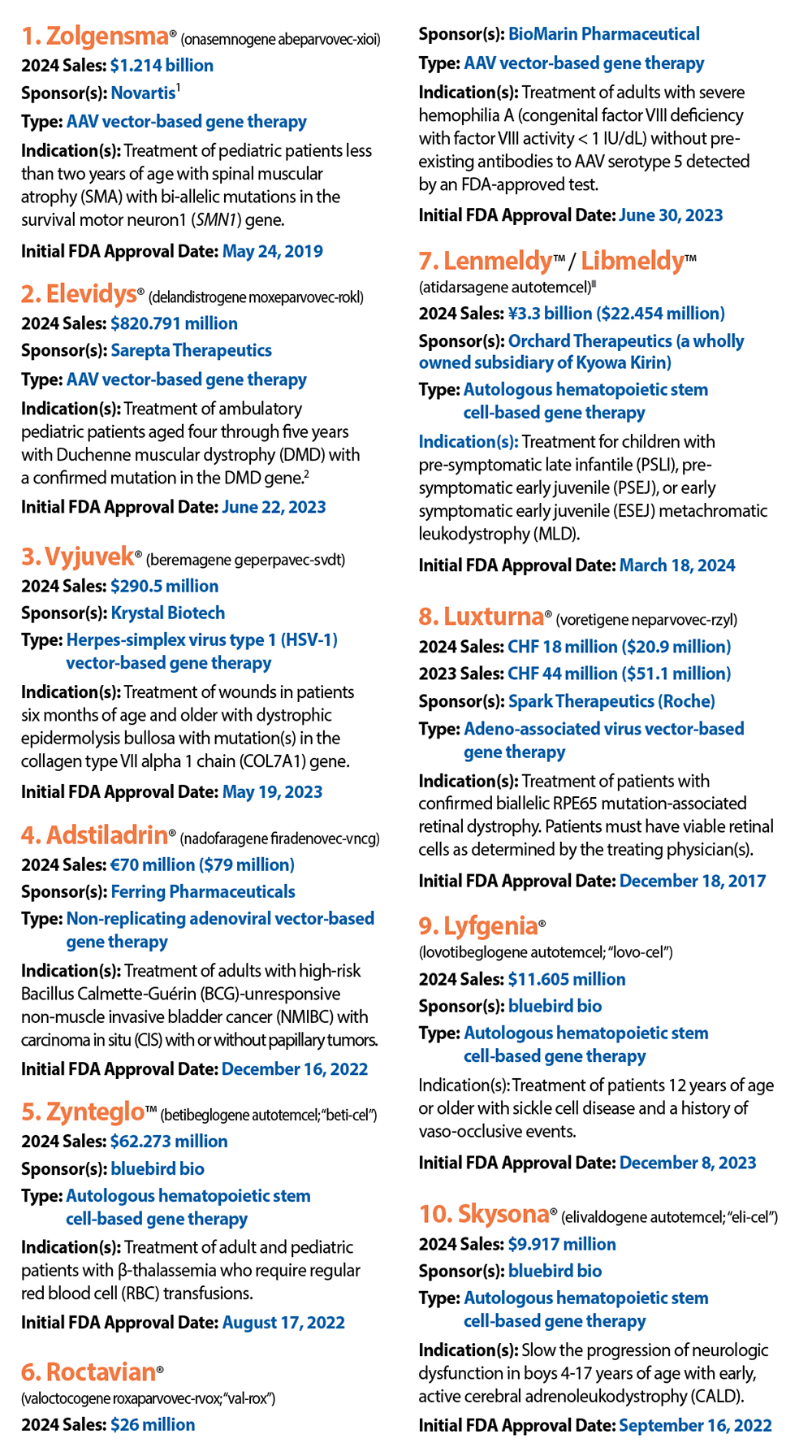
Unlike last year, when GEN included targeted T-cell immunotherapies and other cell therapies in what was a broader list of both cell and gene therapies, this year the gene therapy field has matured enough to have more than 10 gene replacement therapies with disclosed sales figures. According to the American Society of Gene and Cell Therapy (ASGCT), four new gene therapies won FDA approval in 2024. Of those, only one had disclosed sales high enough to be included on this A-List, which ranks top-selling gene therapies based on sales and net product revenue figures furnished by the companies in regulatory filings, annual reports, and/or press releases.
Two therapies with disclosed but low sales are excluded: Beqvez™ (fidanacogene elaparvovec-dzkt), advanced to approvals in April 2024 by Pfizer and Spark Therapeutics; and Casgevy® (exagamglogene autotemcel; “exa-cel”), the history-making CRISPR-edited therapy co-developed by Vertex Pharmaceuticals and CRISPR Therapeutics.
Pfizer cited “the limited interest patients and their doctors have demonstrated in hemophilia gene therapies to date” as explaining why it has halted development and commercialization of Beqvez, which generated no sales in 2024. Effective August 6, Pfizer is terminating its license agreement with Spark for Beqvez, an adeno-associated virus (AAV) vector-based gene therapy indicated for forms of moderate to severe hemophilia B in adults.
Casgevy is an autologous CRISPR genome-edited hematopoietic stem cell-based gene therapy indicated for forms of sickle cell disease (SCD) and transfusion-dependent b-thalassemia (TDT). It generated its first revenue in 2024, $10 million, though its patient uptake has progressed more slowly than analysts expected.
Also not included are gene therapies whose developers have not disclosed sales, including:
- BioVex (Amgen)’s Imlygic® (talimogene laherparepvec), a genetically modified oncolytic viral therapy indicated for local treatment of unresectable cutaneous, subcutaneous, and nodal lesions in patients with melanoma recurrent after initial surgery.
- CSL Behring’s Hemgenix® (etranacogene dezaparvovec), an AAV vector-based gene therapy indicated for adults with Hemophilia B (congenital Factor IX deficiency) who use Factor IX prophylaxis therapy, have current or historical life-threatening hemorrhage, or have repeated serious spontaneous bleeding episodes.
- PTC Therapeutics’ Kebilidi™ (US) / Upstaza™ (ex-US) (eladocagene exuparvovec), an AAV vector-based gene therapy indicated for adults and children with aromatic12 L-amino acid decarboxylase (AADC) deficiency.

References
1. Novartis is the successor to AveXis, which successfully completed the development of Zolgensma in 2019 by receiving FDA approval for the therapy. In 2014, AveXis licensed from REGENXBIO the AAV9 vector used in the Phase I SMA clinical trial at Nationwide Children’s Hospital. REGENXBIO licensed exclusive rights to key intellectual property covering novel recombinant AAV vectors discovered at the University of Pennsylvania in the lab of James M. Wilson, MD, PhD.
2. Following the sudden death of a patient with Duchenne muscular dystrophy (DMD) who had been treated with the company’s marketed gene therapy, recruitment and dosing had been temporarily halted in three clinical studies assessing Elevidys at the request of the European Medicines Agency: ENVOL (NCT06128564); ENVISION (NCT05881408); and Study 104 (NCT06241950). On April 4, Sarepta announced that an independent data monitoring committee concluded that, based on the totality of evidence, the overall benefit-risk profile remained favorable to continue dosing in the paused clinical trials without changes to the study protocols. Sarepta and Roche agreed to submit the information in response to the temporary halt. A decision by European regulators on resuming the studies was pending at deadline.
3. Atidarsagene autotemcel is marketed as Lenmeldy in the U.S. and as Libmeldy within the European Union.