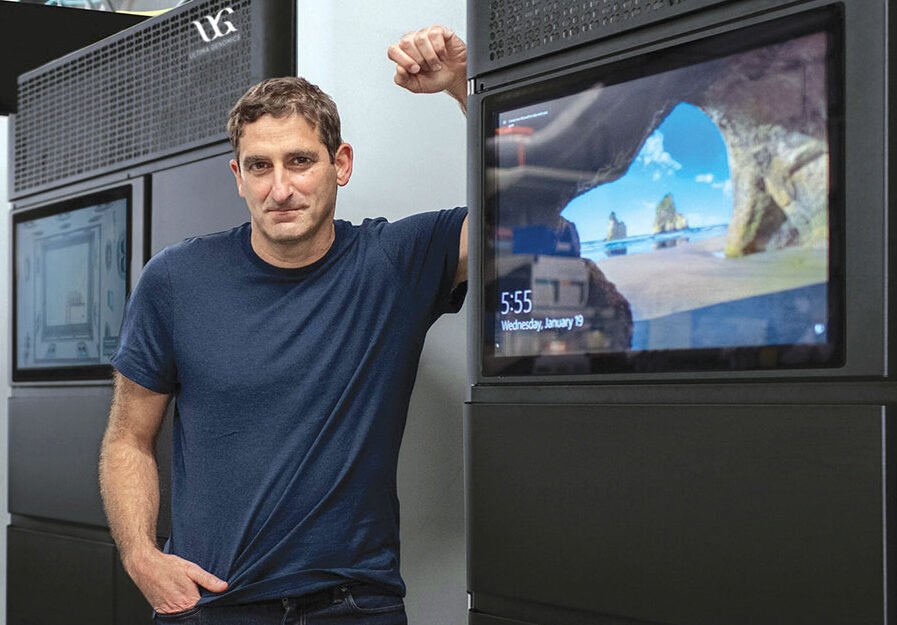
As single-cell genomics experiments grow in size, so too does the need for sequencing. Several large projects have recently called on the relative newcomer to the NGS scene, Ultima Genomics, for their sequencing support. At the American Association for Cancer Research (AACR) meeting in April, GEN sat down with the CEO of Ultima Genomics, Gilad Almogy, PhD, to discuss the momentum surrounding single-cell genomics and his excitement about being a part of it. This article accompanies a feature article focused on large-scale, single-cell genomics projects, The Single Cell Club Is Rapidly Expanding.
There is this moment happening in cellular biology where single-cell is affordable, sequencing is affordable, and AI is real,” Gilad Almogy, PhD, Founder and CEO of Ultima Genomics told GEN. “And CRISPR, and other perturbation methods, are also real. None of these things were true a decade ago, and all of them together weren’t even true until this year—more or less.”
The issue with training AI models, he explains, is that people have various opinions on the scale of data that is needed to train them. But no one has actual proof or conclusive evidence of the scale.
With ChatGPT, Almogy continues, there was an inflection point where the training set of material on the internet got big enough. And boom, the results were disruptive. With self-driving, how many millions of miles had to be driven? In cell biology, where is your training set? For single-cell, you have to go make the data. The entire human cell atlas, which is an amazingly impressive project, currently consists of a little less than a hundred million cells
sequenced over a decade, he notes.
“I did not, when I started the company, see the AI moment happening,” he asserts. “But now, with the benefit of hindsight, it is so obvious that it is maybe one of the most exciting applications. Because the cell is such a complex thing. People have made great progress over the last decades in cell biology, but it’s not physics. In physics, when you are given a few equations and first principles, you can start building it up. The cell is so massively complex and has been impossible to get into equations.”
Proteins needed their AlphaFold moment. They needed AI. A cell is at least one more order of complexity, if not several more. So, it will require massive AI to really make progress in understanding cells.
“Did I have this fundamental belief that biology is data-starved? Absolutely,” he says. “Did I see the Bio AI moment coming in cell biology? Not at all. Am I super excited by
it now? Absolutely.”
The cell is just screaming, “Apply AI to me!”